Find My or Find Hub: which one finds your vehicle?
Both networks do the same job in the same way. What decides which one finds your vehicle is not features - it is how many phones can hear your tracker where you actually park.
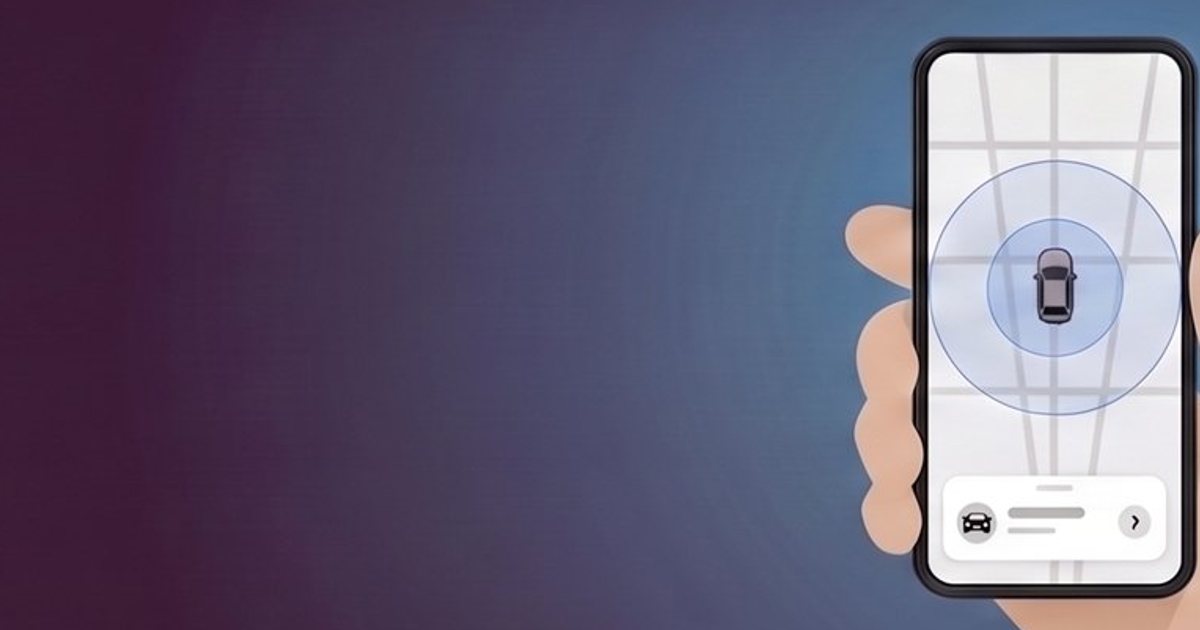
They work identically
A SIM-free tracker does not know where it is. It has no GPS chip, no antenna listening to satellites and no mobile connection of its own. What it does is repeat a short Bluetooth signal, over and over.
Any nearby phone running Apple’s Find My network or Google’s Find Hub network hears that signal, notes its own location, encrypts the pair and passes it on. You open the app and see where a phone was when it last heard your tracker. The phone’s owner learns nothing: they never see the tracker, and the location is encrypted so that neither Apple nor Google can read who was where.
The consequence worth understanding before you buy: the tracker is only as good as the phones around it. In a city, phones are everywhere and updates arrive constantly. On an empty highway at three in the morning nothing hears it, and the last known position is where it stays until someone walks past.
The only difference that matters
Apple’s network is made of iPhones. Google’s is made of Android phones. Neither can hear a tracker built for the other.
India is overwhelmingly an Android market, so a Find My-only tracker is listening for a minority of the phones around it. In an affluent urban pocket that minority is still large. Outside one, it can be thin.
Which is why the phone you carry is the wrong thing to optimise for. You will open the app perhaps twice in the tracker’s life. What decides whether there is anything to see is the phones passing your vehicle while you are asleep.
What a dual-network tracker changes
A tracker visible to both networks is heard by both crowds. That is not a marketing improvement, it is arithmetic: every phone that passes is a chance of a position, and doubling the eligible phones roughly doubles the chances.
The ZeroLoss Tracker is dual-network for this reason. It answers Find My and Find Hub at once, so an iPhone or an Android passing the vehicle both count.
Neither is a live tracker
Worth being blunt, because the apps invite the wrong expectation. You are not watching a vehicle move. You are seeing where a phone was when it last heard your tag. In traffic that can update every few minutes; on a quiet road it may not update for hours.
If you need a live route, a speed trail or geofence alerts, you want a SIM-based tracker and the running cost that comes with it.
A SIM-based tracker carries its own modem and reports its position directly, so it works where no phone ever goes. That is a real advantage and it deserves saying plainly.
What it costs you is ongoing: a plan billed monthly or yearly, a battery that needs charging or wiring into the vehicle, and a subscription that quietly switches your tracker off when a payment fails. It is also easier to find, because a wired unit has to sit somewhere a mechanic can reach.
Frequently asked questions
Can an Android phone find an AirTag?
It can scan for a nearby unknown tag to protect against stalking, but it cannot report an AirTag position into Apple’s network. Only iPhones do that.
Which network is bigger in India?
Android has far more handsets in India, though iPhones cluster in cities. A dual-network tracker sidesteps the question by using both.
Do I need both an iPhone and an Android phone?
No. You need one phone to see the map. The rest are strangers’ phones, and they do the finding whether you own that brand or not.
The ZeroLoss Tracker
Dual-network, SIM-free and ₹999 with no subscription. Visible to Apple Find My and Google Find Hub at once, so both crowds of phones can hear it.
See the tracker